
UN 38.3 Explained: The Test Every Lithium Battery Must Pass
Before a lithium cell or battery can travel by road, rail, sea or air as ordinary dangerous goods, its design type must have passed the UN 38.3 test series. This guide explains what the eight tests check, how cells, batteries and assemblies are treated, when a design change forces re-testing, how to read a test summary, and what happens when a tested battery is damaged, still a prototype or based on sodium-ion chemistry.
1. What UN 38.3 Is and Why Every Battery Shipment Depends on It
UN 38.3 is shorthand for subsection 38.3 of the UN Manual of Tests and Criteria, Part III. It sets out a series of tests that a lithium cell or battery type must pass before it can be offered for transport under the normal lithium battery entries, such as UN 3480 and UN 3481 for lithium-ion or UN 3090 and UN 3091 for lithium metal. The current version is the eighth revised edition of the Manual (2023), with Amendment 1 (2025), which also brings sodium-ion cells and batteries with organic electrolyte into scope.
The tests do not certify that a battery is safe in every use. They show that a design type can withstand the conditions it is likely to meet in transport: low pressure in an aircraft hold, temperature swings, vibration, shocks, external short circuits, mechanical abuse and, for rechargeable designs, overcharging. If the design type fails, the battery cannot be shipped as a routine consignment. If it was never tested, it can only move under the special rules for prototypes and small production runs.
For everyone downstream of the factory, UN 38.3 is the foundation of the paperwork. A distributor reselling cells, an OEM building packs into machines, a forwarder booking a container and a carrier accepting it all rely on the same assumption: that the battery belongs to a type that passed.
- Who it affects. Cell and battery manufacturers, importers, pack assemblers, equipment and vehicle OEMs, distributors and the logistics and dangerous goods staff who check their documents.
- What it covers. Small and large lithium-ion and lithium metal cells and batteries, and since 2025 sodium-ion cells and batteries, whether shipped alone, packed with equipment or contained in it.
- What it does not cover. The condition of an individual battery after it leaves production. A battery that passed as a type can still be damaged, defective or of unknown condition later.
That last point matters for anyone handling returns, recalls or recovered packs. A UN 38.3 pass describes the design, not the history of a specific unit; our explainer on when a pack counts as damaged or defective picks up where the type test stops. It is also worth separating battery tests from packaging tests: containment for damaged batteries goes through its own approval, and knowing how containment packaging is itself fire-tested helps avoid confusing the two.
Key principle: UN 38.3 is a design type test. It proves that a battery type can survive the stresses of transport. It says nothing about whether a particular battery in front of you is still in the condition that was tested.
2. Where UN 38.3 Sits in the Dangerous Goods Framework
The UN Recommendations on the Transport of Dangerous Goods consist of two linked publications: the Model Regulations, which set out classification, packing and documentation, and the Manual of Tests and Criteria, which describes the tests behind those rules. The modal regulations then transpose both into binding law for each mode of transport. Each of them makes UN 38.3 a condition for carrying lithium and sodium-ion batteries under their standard entries, and each requires the test summary to be made available.
| Instrument | Scope | Where the test summary requirement sits |
|---|---|---|
| UN Manual of Tests and Criteria | Defines the tests (38.3.4), re-testing triggers (38.3.2.2) and the content of the test summary (38.3.5) | 38.3.5 |
| ADR / RID / ADN | Road, rail and inland waterway carriage in Europe and beyond | 2.2.9.1.7.1 (g) for lithium; 2.2.9.1.7.2 (f) for sodium-ion |
| IMDG Code | Sea transport | 2.9.4.7 for lithium; 2.9.5.6 for sodium-ion |
| ICAO TI / IATA DGR | Air transport | DGR 3.9.2.6.1 (g) for lithium; 3.9.2.7.1 (f) for sodium-ion |
The same ADR, IMDG and DGR paragraphs also contain the other classification conditions for batteries, including a quality management programme for manufacture and protective features such as protection against short circuits. Passing UN 38.3 is necessary, but it is not the only condition for classification under the standard entries.
Air is the strictest mode in several respects. IATA’s 2026 guidance confirms that cells and batteries which have not passed UN 38.3 may only be carried by air under State approval, and that damaged or defective batteries with the potential to produce a dangerous evolution of heat, fire or short circuit are forbidden by air altogether. For shippers weighing the two international codes against each other, our article comparing the IMDG Code with the IATA DGR sets out where the battery rules differ.
3. The Eight Tests, One by One
The test series is designed to simulate transport conditions and foreseeable abuse. The parameters below are taken from the Manual’s test descriptions as reproduced in laboratory test reports; always work from the edition and amendment that applies to your design type, because details have changed between editions. For most tests, the pass criteria include no leakage, no venting, no disassembly, no rupture and no fire, plus limits on mass loss and voltage drop.
Taken together, the series probes the conditions that can push a cell into the self-sustaining heat release that every dangerous goods rule for batteries ultimately guards against. If you want to understand the runaway reaction these tests aim to prevent, including how it spreads between cells, our explainer covers the chemistry and the escalation.
4. Cells, Batteries and Assemblies: What Gets Tested and in Which Order
The Manual distinguishes between cells, batteries and assembled batteries, and between small and large batteries. Laboratory test reports apply the Manual’s threshold of 12 kg gross mass to separate small from large batteries, which changes several test parameters and the number of samples.
- Tests T.1 to T.5 are run in sequence on the same samples. A cell or battery must survive altitude, thermal cycling, vibration, shock and short circuit one after the other.
- T.6 and T.8 use samples not otherwise tested. Both are tests on cells or component cells.
- T.7 applies to rechargeable batteries, including single-cell rechargeable batteries, and the Manual allows undamaged batteries from T.1 to T.5 to be used for testing on cycled batteries.
- Rechargeable designs are tested in more than one state. Sample tables in laboratory reports include fresh samples at first cycle and samples that have completed 25 charge and discharge cycles.
- Sample numbers vary. They depend on whether the item is a cell, a small battery or a large battery and on its state of charge or cycling. Agree the exact matrix with your test laboratory for the edition that applies.
4.1 Batteries built from tested cells
A frequent misunderstanding is that a pack built from tested cells needs no further testing. In general, the battery itself is a design type in its own right, with its own wiring, protective devices, housing and mass, and the battery must be tested as well as the cells. The Manual contains specific provisions, in paragraphs 38.3.3 (f) and (g), for batteries assembled from batteries or cells that have already passed; that is why the test summary must reference those paragraphs whenever they were applied. If you integrate packs from third-party cells, ask your laboratory which route applies before assuming that existing cell reports are enough.
For vehicle and equipment makers this has practical consequences: a new module, a change of busbar layout or a new battery management system can turn an existing pack into a new type. Teams building traction or industrial packs at volume often plan transport testing and packaging together, and our page on containment for EV makers and pack integrators shows how that fits into production, recall and return flows.
5. When You Must Re-test
A UN 38.3 pass belongs to a design type. Paragraph 38.3.2.2 of the Manual, as quoted in IATA’s 2026 guidance, says that a cell or battery is a new type, and must be tested again, if it differs from the tested design by:
- for primary cells and batteries, a change of more than 0.1 g or 20 per cent by mass, whichever is greater, to the cathode, the anode or the electrolyte;
- for rechargeable cells and batteries, a change in watt-hours of more than 20 per cent or an increase in voltage of more than 20 per cent; or
- a change that might materially affect the test results.
The Manual lists examples of changes that may fall under that third heading:
- a change in the material of the anode, cathode, separator or electrolyte;
- a change of protective devices, including hardware and software;
- a change of safety design, such as a venting valve;
- a change in the number of component cells or in the way they are connected;
- for batteries tested under T.4 with a peak acceleration below 150 gn, a change in mass that could adversely affect the T.4 result; and
- repairing, refurbishing or remanufacturing, including replacement with non-original spares or parts of a different specification, in a way that deviates from the tested type.
In practice, a battery management software update can be a design change, so engineering change control should include a transport-testing check. Refurbished packs need the same scrutiny: unless the work keeps the battery within the tested type, the original test summary no longer covers it. IATA’s guidance also notes that a test summary has no expiry date: it stays valid as long as the type has not changed in a way that requires re-testing.
6. The Test Summary: Contents, Responsibilities and How to Check One
Since 1 January 2020, manufacturers and subsequent distributors of lithium cells and batteries, and of equipment containing them, must make available a test summary as specified in paragraph 38.3.5 of the Manual. Since 1 January 2025 the same applies to sodium-ion cells and batteries. Button cells installed in equipment, including circuit boards, are excepted. “Make available” means that anyone in the supply chain, such as a consignor, carrier, regulator or customer, can obtain it. IATA accepts publication on a website referenced by a QR code or URL on the battery, its packaging or the transport documents, and it is not a document that must accompany every consignment.
There is no mandatory format, but every test summary must contain these ten elements:
| Item | Required content |
|---|---|
| (a) | Name of the cell, battery or product manufacturer, as applicable |
| (b) | Manufacturer’s contact information: address, phone number, email address and website |
| (c) | Name of the test laboratory, with address, phone number, email address and website |
| (d) | A unique test report identification number |
| (e) | Date of the test report |
| (f) | Description of the cell or battery: chemistry (lithium-ion, lithium metal or sodium-ion), mass, watt-hour rating or lithium content, physical description and model numbers |
| (g) | List of tests conducted and results (pass or fail) |
| (h) | Reference to assembled battery testing requirements, if applicable (38.3.3 (f) and (g)) |
| (i) | Reference to the revised edition of the Manual used, and any amendments |
| (j) | Name and title of the responsible person, as an indication of the validity of the information |
IATA’s guidance confirms that one summary may cover several batteries, products or test houses, provided every required element is present and each item listed has its own test report number and date. TÜV Rheinland adds a useful warning: informal confirmation letters or a blanket statement in a safety data sheet are not a substitute for a compliant test summary.
6.1 How to read one
Start with the match between document and product. The model number, mass and watt-hour rating on the summary should agree with the label on the battery, the safety data sheet and the commercial invoice. Then check the test list: all applicable tests should be listed as passed, and a test marked not applicable should make sense for the item, such as T.7 for a primary battery or T.8 for a sodium-ion battery. Finally, check the edition reference against the date of the report.
Red flags in a test summary: no test laboratory named, or a laboratory without contact details; no unique report number or date; no reference to the Manual edition and amendment; a model number, mass or watt-hour rating that differs from the product; a “generic” summary that covers a product family without listing models; no responsible person named; or a summary for the cell when you are shipping an assembled battery. Any of these is a reason to go back to the supplier before the battery moves.
Logistics teams increasingly ask for the test summary at booking, and they are right to do so. Our guide to what forwarders should ask shippers before booking places the test summary alongside the other documents a desk should request.
7. When UN 38.3 Is Not Enough
UN 38.3 covers the normal case: new batteries of a tested type. Three situations fall outside it, and each has its own rules.
7.1 Damaged, defective and unknown-condition batteries
A battery that was tested as a type can be dropped, crushed, flooded, overheated or recalled. Once a battery is identified as damaged or defective so that it no longer conforms to the tested type, its UN 38.3 status no longer makes it safe to ship as a routine consignment. Special provision 376 then applies, whatever testing the type went through. Batteries not liable to react dangerously under normal conditions of carriage are packed under P908 or LP904; batteries liable to rapidly disassemble, react dangerously, produce a flame or a dangerous evolution of heat, or emit toxic, corrosive or flammable gases, are packed under P911 or LP906 in packaging shown to contain those effects. By air, such batteries are forbidden.
This is where most real-world cases sit: traction packs coming back under warranty, packs pulled from collision-damaged vehicles and modules leaving decommissioned storage sites. In each, the original test summary describes the type the battery once belonged to, not its present condition. Where condition cannot be confirmed, treat the battery as belonging to the higher tier and involve your DGSA.
BUNCKER® does not test batteries and does not replace UN 38.3. Its role starts where the test summary stops being enough. All six Pro Line Heavy models are UN LP906 certified for road (ADR), sea (IMDG) and rail (RID) and for indoor and outdoor storage: the side-loading SDR (45.8 kWh) for batteries in any status, and the S (50 kWh), M (90 kWh), L (90 kWh), XL (100 kWh) and XXL (200 kWh). Each uses a patented bell jar with no filler materials, a Fibercon Altilium® CP Blanket (FACB) that chemically neutralises HF, and keeps its outer surface below 100 °C during a full thermal runaway. They are made in the Netherlands by VDL. The documentation for the BUNCKER® approvals under P911 and LP906 sets out the certification scope, and the full BUNCKER® model line-up lists dimensions and capacities.
Certified Containment for Batteries Beyond Their Test Status
When a tested battery is damaged, defective or of unknown condition, SP 376 decides how it travels. BUNCKER® Pro Line Heavy units are UN LP906 certified for road, sea and rail transport and for indoor and outdoor storage, with HF neutralisation and no filler materials. Always check fit against the dimensions and weight of your specific battery.
See P911 and LP906 compliance →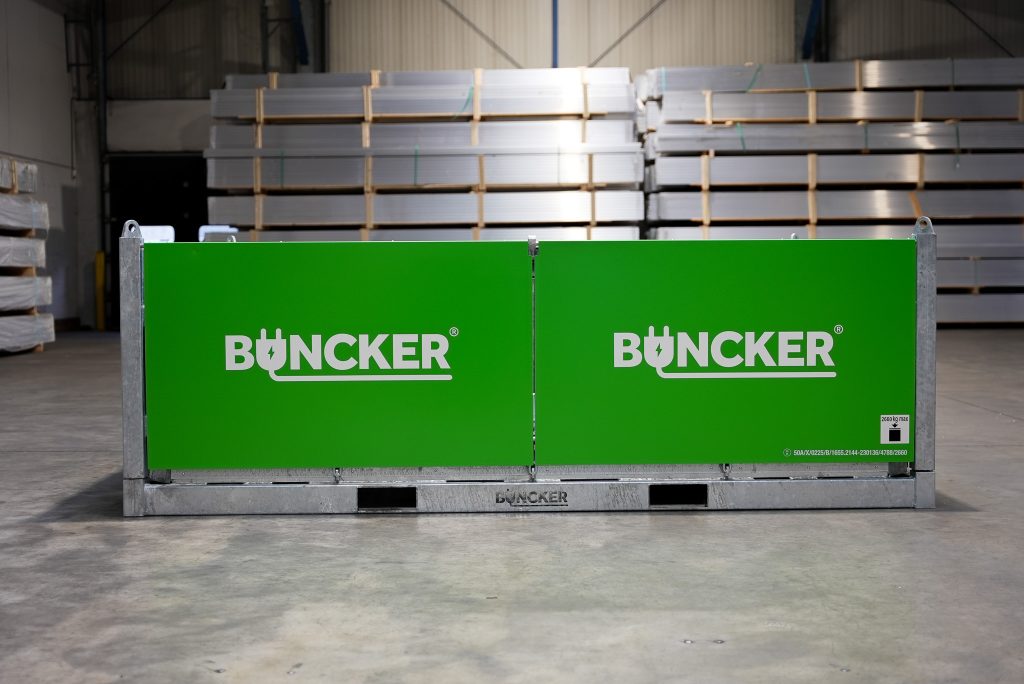
7.2 Prototypes and small production runs
Development batteries usually move before testing is complete, often to the test laboratory itself. For road, rail and sea, special provision 310 covers cells and batteries from production runs of not more than 100 cells or batteries, and pre-production prototypes transported for testing. They must be packed according to packing instruction P910 or LP905, as applicable, and the transport document must include the statement “Transport in accordance with special provision 310”. By air, IATA special provision A88 allows pre-production prototypes and low production runs (no more than 100 cells or batteries a year) on cargo aircraft only, with approval from the State of Origin and the State of the Operator.
P910 and LP905 set their own packaging requirements. If you are planning prototype shipments, confirm the packaging scope for your specific case with the BUNCKER® team and your DGSA before choosing containment; LP906 certification for damaged batteries should not be assumed to cover untested prototypes. Defence programmes face a similar sequencing problem, and our article on defence programmes that add environmental qualification explains how UN 38.3 relates to the military test standards that sit on top of it.
7.3 Sodium-ion differences
Sodium-ion cells and batteries with organic electrolyte are covered by UN 38.3 under the eighth revised edition and its amendment, and by their own UN entries, UN 3551 and UN 3552. Most of the test series is the same, but the forced discharge test T.8 is not required for sodium-ion. The test summary requirement has applied to sodium-ion since 1 January 2025, and the summary must state sodium-ion as the chemistry. Before assigning a lithium number to a new chemistry, check the sodium-ion classification rules for the entries and conditions that apply.
8. Checklist for Buyers, Importers and Logistics Teams
Use this list when onboarding a new battery supplier, approving a product for sale or accepting a consignment.
- ✅ Test summary on file. Do you hold a test summary for every cell, battery and battery-powered product, or a reliable link to one?
- ✅ All ten elements present. Manufacturer, contacts, laboratory, unique report number, date, description, test results, assembly reference where applicable, Manual edition and responsible person.
- ✅ Product match. Do model number, mass and watt-hour rating or lithium content agree with the label, safety data sheet and invoice?
- ✅ Right level tested. Is there a summary for the battery you are shipping, not only for its cells?
- ✅ No unrecorded changes. Has the supplier confirmed that cells, protective devices, software, cell count and connections are unchanged since testing?
- ✅ Refurbished stock checked. Are repaired or remanufactured batteries still within the tested type, or have they been re-tested?
- ✅ Prototypes identified. Are untested prototypes and small runs routed under SP 310 or SP A88, never shipped as tested batteries?
- ✅ Condition known. Are returned, recalled, damaged and unknown-condition batteries classified under SP 376 and kept off aircraft?
- ✅ Chemistry correct. Are sodium-ion batteries shipped under UN 3551 or UN 3552, with a summary that states the chemistry?
- ✅ Records kept. Can you produce the summary quickly when a carrier, customer or authority asks?
Bottom line: UN 38.3 is the entry ticket for every lithium and sodium-ion battery in normal transport. Check that the test summary is complete and matches the product, re-test when the design changes, route prototypes under their own provisions and, once a battery is damaged or its condition is unknown, stop relying on its test status and follow SP 376.
Frequently Asked Questions
Frequently Asked Questions
No. UN 38.3 is a test series in the UN Manual of Tests and Criteria. A design type either passes or fails, and the result is documented in a test report and a test summary under paragraph 38.3.5. The test summary is what manufacturers and distributors must make available.
In general, yes. The battery is a design type in its own right. The Manual has specific provisions for assembled batteries in 38.3.3 (f) and (g), and the test summary must refer to them where they were used. Confirm the route with your test laboratory.
No. According to IATA’s guidance, the summary stays valid as long as the cell or battery type has not been changed in a way that requires re-testing under 38.3.2.2.
No. The requirement is to make it available on request. A website link or QR code on the battery, its packaging or the transport documents is accepted, although individual carriers and customers may ask for a copy before accepting a booking.
Not as a routine consignment. A battery identified as damaged or defective falls under special provision 376, regardless of the testing its type passed, and must be packed under P908/LP904 or P911/LP906 depending on its risk. Damaged or defective batteries are forbidden by air.
By road, rail and sea under special provision 310, packed according to P910 or LP905, with the SP 310 statement on the transport document. By air only on cargo aircraft under special provision A88, with approval from the State of Origin and the State of the Operator. Check packaging scope with your supplier and DGSA.
Largely. Sodium-ion cells and batteries with organic electrolyte are covered by the eighth revised edition of the Manual and its amendment, but the forced discharge test T.8 is not required. A test summary has been required for sodium-ion since 1 January 2025.
When the Test Summary Is No Longer Enough
BUNCKER® units are UN LP906 certified for road, sea and rail transport and for indoor and outdoor storage, with HF neutralisation and no filler materials required. Our specialists can help you choose containment for damaged, defective or unknown-condition batteries.