
Freight Forwarders and Lithium Batteries: Accepting Shipments Safely
Forwarders, 3PLs, NVOCCs and carrier booking desks sit between the shipper who knows the battery and the operator who has to move it. This guide explains how to accept, book and route lithium and sodium-ion battery consignments without inheriting someone else’s non-compliance: who is responsible for what, which questions to ask before quoting, how to spot high-risk loads, what each mode requires and when to say no.
1. Why Forwarders Carry More Battery Risk Than They Think
Lithium batteries used to be a niche for most forwarding offices. Today they arrive at the booking desk as electric vehicle packs, stationary storage modules, warranty returns, production scrap and end-of-life batteries heading for recyclers. Many are large, many are not new, and some are in a condition nobody has formally assessed.
The forwarder rarely sees the battery, only a booking request, an invoice and perhaps a safety data sheet. Yet it chooses the carrier, route and mode, often consolidates cargo and sometimes prepares the dangerous goods documents. Each of those steps can turn an intermediary into a participant with its own legal duties.
- Used and returned batteries. A battery removed from service or sent back under warranty may be damaged or defective even if it looks intact. Its classification depends on its condition, not on the purchase order.
- Misdeclaration. Batteries are sometimes declared as spare parts, electronics or machinery. A forwarder that books such cargo without asking questions can end up holding the consequences.
- Multimodal chains. One consignment can combine road, sea and rail legs. A battery acceptable on one leg may be forbidden on another.
- Penalties and liability. Enforcement varies by jurisdiction, but consequences can include fines, detention of the vehicle or shipment, and civil liability for damage to other cargo, vessels or premises.
Forwarders that handle battery flows at volume increasingly build containment into their service offer rather than leaving it to each shipper; our overview of certified containment for forwarders and 3PLs shows how that works in practice.
Key principle: the safest booking is the one where every question about the battery has been answered before a price is quoted. Uncertainty that is accepted at the desk is passed on to the driver, the warehouse and the vessel.
2. Who Is Responsible for What
ADR, the agreement for the carriage of dangerous goods by road, sets out the safety obligations of the participants in Chapter 1.4. RID follows the same structure for rail. Section 1.4.1 requires every participant to take appropriate measures, according to the nature and extent of foreseeable dangers, to avoid damage and to minimise its effects. Sections 1.4.2 and 1.4.3 then list specific duties for each role. A note to 1.4.2 makes an important point for forwarders: several participants can be the same undertaking, and one participant’s activities can be split across several undertakings.
| Participant | ADR reference | Core duties relevant to batteries |
|---|---|---|
| Consignor | 1.4.2.1 | Hands over only consignments that comply with ADR; ascertains that the goods are classified and authorised for carriage; provides the carrier with the information and documents required; uses only approved and suitable packagings |
| Carrier | 1.4.2.2 | Checks that the goods are authorised for carriage and that the prescribed information and documents are available; visually checks vehicle and load for obvious defects; must not carry a consignment found to be non-compliant until it is put right (1.4.2.2.3) |
| Consignee | 1.4.2.3 | Must not defer acceptance without compelling reason and must check, after unloading, that its requirements under ADR are met |
| Loader | 1.4.3.1 | Hands goods to the carrier only if authorised for carriage; checks packagings for damage and does not hand over a damaged package until it is remedied; observes mixed loading prohibitions, taking account of dangerous goods already on the vehicle or in the container |
| Packer | 1.4.3.2 | Complies with the packing requirements and, when preparing packages for carriage, with marking and labelling requirements |
| Unloader | 1.4.3.7 | Checks that the correct goods are unloaded and that packagings have not been damaged in a way that endangers the operation |
2.1 When the forwarder becomes the consignor
ADR defines the consignor in 1.2.1 as the enterprise which consigns dangerous goods either on its own behalf or for a third party, and where carriage is performed under a contract for carriage, as the consignor according to that contract. A forwarder that books road carriage in its own name, signs the contract with the haulier and appears as consignor on the transport document therefore takes on the consignor’s duties under 1.4.2.1, whatever its contract with the shipper says.
ADR anticipates this. Under 1.4.2.1.3, where the consignor acts on behalf of a third party, that third party must inform the consignor in writing that dangerous goods are involved and provide all the information and documents it needs. Under 1.4.2.1.2, a consignor that uses the services of other participants, such as a packer or loader, may rely on the information and data they provide for classification, documents and packaging. For a forwarder, the practical message is clear: get the shipper’s dangerous goods information in writing, keep it, and make sure it is complete before the goods move.
The same logic applies at sea. When a forwarder or consolidator stuffs a container with cargo from several shippers, it is normally the party that signs the container packing certificate, and with it takes responsibility for the stowage and segregation of everything in the box.
2.2 The Dangerous Goods Safety Adviser
Under ADR 1.8.3.1, each undertaking whose activities include the consigning or the carriage of dangerous goods by road, or the related packing, loading, filling or unloading, must appoint one or more safety advisers, subject to the exemptions in 1.8.3.2. UK guidance from the Health and Safety Executive notes that intermediate unloaders, such as freight forwarders and consolidators, need a DGSA. If your warehouse cross-docks battery consignments, or your company appears as consignor, involve your DGSA in the procedures described in this article. Containment and good intake questions support the adviser’s work; they do not replace it.
3. The Intake Conversation: Questions to Ask Before Quoting
Most problems can be found in a short conversation with the shipper. Build these questions into your quotation form or booking portal.
Do not forget the newer chemistries. Sodium-ion batteries have their own entries, UN 3551 and UN 3552, and since ADR 2025 special provisions 376 and 377 and packing instructions P908/LP904, P909 and P911/LP906 apply to them as well. If a shipper is unsure, our guide to classifying Na-ion cells for transport explains which entry applies before a lithium number is assumed. Equally, if the cargo is a complete vehicle rather than a loose battery, check the entry: since ADR 2025, lithium-ion powered vehicles are UN 3556.
4. Recognising High-Risk Consignments
New batteries from a manufacturer, tested and packed to the applicable packing instruction, are the routine end of the market. The risk sits elsewhere: in batteries whose condition is not what the paperwork assumes.
- Used batteries. Batteries removed from vehicles, machines or storage systems have a service history. Without a documented assessment, their condition is unknown.
- Warranty returns. A battery comes back because something was wrong with it. Treat every return as potentially defective until an assessment says otherwise.
- Damaged batteries. Impact, crushing, water ingress, heat exposure, swelling, leaks or a deformed casing all point to damage, as do batteries recovered from vehicles involved in collisions. Our article on recovering crashed electric vehicles covers that scenario from the recovery yard onwards.
- Recalled batteries. Batteries recalled by the manufacturer for safety reasons are, by definition, suspected of a defect.
- Batteries for recycling. End-of-life batteries are often collected in mixed condition. Intact ones may travel under SP 377 and P909, but damaged ones fall under SP 376. The wider flow of waste batteries on their way to treatment plants is a route where forwarders increasingly take a coordinating role.
- Unknown condition. Batteries without data, without history or without a responsible person who can vouch for them belong in the most severe category until proven otherwise.
4.1 SP 376 and the packaging tiers
Special provision 376 governs lithium and sodium-ion cells and batteries identified as damaged or defective. It splits them into two tiers. Batteries that are not liable to react dangerously under normal conditions of carriage are packed under P908 or LP904. Batteries that are liable to rapidly disassemble, react dangerously, produce a flame or a dangerous evolution of heat, or emit toxic, corrosive or flammable gases or vapours are packed under P911 or LP906, in packaging that has been shown to contain those effects.
The tier decision belongs to the consignor and its DGSA, not to the booking desk. But the forwarder should know enough to recognise when a shipper is understating the risk. If a shipper declares a returned, swollen pack as a routine UN 3480 consignment, something is wrong. Our explainer on grading a faulty battery under SP 376 walks through the criteria in more detail. Large stationary storage modules raise the same questions at greater scale, and our guide to shipping modules from retired grid storage shows how the assessment works for those consignments.
Rule of thumb for the desk: if the shipper cannot say with confidence that a battery is intact, it should not be booked as intact. Ask for the SP 376 assessment, or for the battery to travel in packaging approved for the higher tier.
5. Documentation and Marking per Mode
Each mode has its own documentary chain. The content overlaps, but the form, the signatory and the acceptance check differ.
- Road (ADR) and rail (RID). The consignor provides a transport document with the particulars of ADR 5.4.1.1: UN number, proper shipping name, class, packages, total quantity, consignor, consignee and, where applicable, the tunnel restriction code. RID follows the same structure in the consignment note.
- Sea (IMDG Code). The shipper provides the dangerous goods transport document (5.4.1). Whoever packs the container provides a container/vehicle packing certificate (5.4.2), confirming that packages were inspected, only sound packages loaded and the unit correctly marked and placarded. The two can be combined on one multimodal form.
- Air (IATA DGR). Fully regulated lithium battery shipments require a Shipper’s Declaration for Dangerous Goods, and the operator performs its own acceptance check using a checklist.
| Mode | Key documents | Intact UN 3480 / UN 3551 | Damaged or defective (SP 376) |
|---|---|---|---|
| Road (ADR) | Transport document (5.4.1), instructions in writing, Class 9 marks and labels | Permitted per packing instruction | Conditions P908/LP904 or P911/LP906 |
| Rail (RID) | Consignment note with dangerous goods particulars | Permitted per packing instruction | Conditions P908/LP904 or P911/LP906 |
| Sea (IMDG) | DG transport document (5.4.1), container/vehicle packing certificate (5.4.2) | Permitted subject to line acceptance | Conditions tiered packaging, line acceptance |
| Air (IATA DGR) | Shipper’s Declaration for Dangerous Goods, operator acceptance check | Cargo aircraft only max 30% state of charge | Forbidden regardless of packaging |
The forwarder’s job is not to rewrite the declaration but to check that documents agree with each other and with what is handed over. A UN number that does not match the safety data sheet, or a “used” battery declared as new, is a reason to stop and ask.
6. Booking and Routing
6.1 Airline and shipping line acceptance
Regulations set the minimum; carriers add their own acceptance policies. Airlines publish operator variations, and shipping lines may require pre-approval or specific stowage, or decline damaged batteries outright. Before quoting, confirm acceptance in writing with the actual operator for each leg, for the specific UN number, special provision and packaging. A rate is not acceptance.
6.2 Why air is off the table for damaged batteries
Under the IATA rules, lithium batteries that are damaged or defective, or that have been recalled for safety reasons, and that have the potential to produce a dangerous evolution of heat, fire or short circuit are forbidden for air transport. No packaging changes that. Intact UN 3480 lithium-ion batteries and UN 3551 sodium-ion batteries shipped on their own are forbidden on passenger aircraft, may only travel on cargo aircraft, and are limited to a state of charge of 30 per cent of rated capacity. If a customer needs a damaged battery moved urgently across a continent, the answer is road, rail or sea with the right packaging, not air. The differences between the two international codes are summarised in our comparison of IMDG and IATA lithium battery provisions.
6.3 Planning multimodal legs
Plan multimodal routes backwards from the most restrictive leg: packaging approved for every mode, acceptance from each carrier, documents for each regime. Every repack at a terminal adds handling risk and a new packer. For damaged batteries, one packaging that stays with the battery from origin to destination removes those handovers.
6.4 Consolidation and mixed loads
Groupage is where forwarders most often move from intermediary to participant. When battery packages share a trailer or a container with other cargo, the loader must observe the mixed loading prohibitions of ADR, taking account of dangerous goods already in the vehicle or container, and at sea the IMDG segregation requirements apply. Practical rules for the warehouse:
- Inspect every battery package at intake and refuse damaged or leaking packages; the loader may not hand them over until the defect is remedied.
- Keep damaged, defective and unknown-condition batteries separate from intact battery stock and from other cargo while they wait.
- Make sure the person signing the container packing certificate has actually checked the load.
A pallet waiting for a vessel cut-off sits in your shed, under your fire risk assessment. For layout, distances and detection, our guidance on holding battery freight at cross-dock hubs applies directly to forwarding warehouses.
7. Where Certified Containment Fits for Forwarders
Most battery freight does not need special containment. Certified containment earns its place in three situations forwarders meet regularly.
- Batteries of uncertain or damaged condition. Where SP 376 requires P911 or LP906, or where the condition cannot be confirmed, the battery needs packaging that has been shown to contain a thermal runaway. Knowing what an LP906 test report has to demonstrate helps you check a supplier’s claims rather than take them on trust.
- Multimodal road, rail and sea legs. A unit certified for ADR, RID and the IMDG Code can stay with the battery across the whole surface route, without repacking at a port or rail terminal.
- Interim storage at hubs. Units also approved for indoor and outdoor storage let a forwarder hold a high-risk battery between legs without improvising a quarantine area.
The hazards that containment addresses are heat, flame and gas. Our explainer on thermal runaway in lithium-ion cells describes how a failing battery escalates, and the briefing on the HF risk for warehouse and terminal staff explains why the toxic gases matter as much as the fire in an enclosed shed or container.
7.1 The BUNCKER® range
All six BUNCKER® models are UN LP906 certified: the side-loading SDR (45.8 kWh) for batteries in any status, and the S (50 kWh), M (90 kWh), L (90 kWh), XL (100 kWh) and XXL (200 kWh). They are certified for road (ADR), sea (IMDG) and rail (RID) and for indoor and outdoor storage, so one unit can stay with the battery across road, rail and sea legs. Each is built around a patented bell jar with no filler materials; the Fibercon Altilium® CP Blanket (FACB) chemically neutralises HF, and the outer surface stays below 100 °C during a full thermal runaway. Units are made in the Netherlands by VDL, supported by a certified service and inspection programme and delivered from stock.
For freight professionals, buncker.com recommends the XL and XXL: BUNCKER® Model XL for palletised battery freight is rated up to 100 kWh, and the XXL up to 200 kWh for the largest packs. Always check the battery’s dimensions and mass against the datasheet, and use a checklist for specifying battery containment when comparing options.
Air remains outside this picture. Damaged or defective batteries cannot fly, whatever packaging they are in. Containment changes how safely a battery travels by road, rail and sea; it does not change the shipper’s duty to classify the battery correctly, nor the role of your DGSA.
BUNCKER® Model XL for Freight and Logistics
Certified containment rated up to 100 kWh for battery freight of uncertain or damaged condition, with HF neutralisation and no filler materials. UN LP906 certified for road, sea and rail transport and for indoor and outdoor storage, so one unit can stay with the battery from collection to consignee. Always check fit against the dimensions and weight of your specific battery.
See freight and logistics solutions →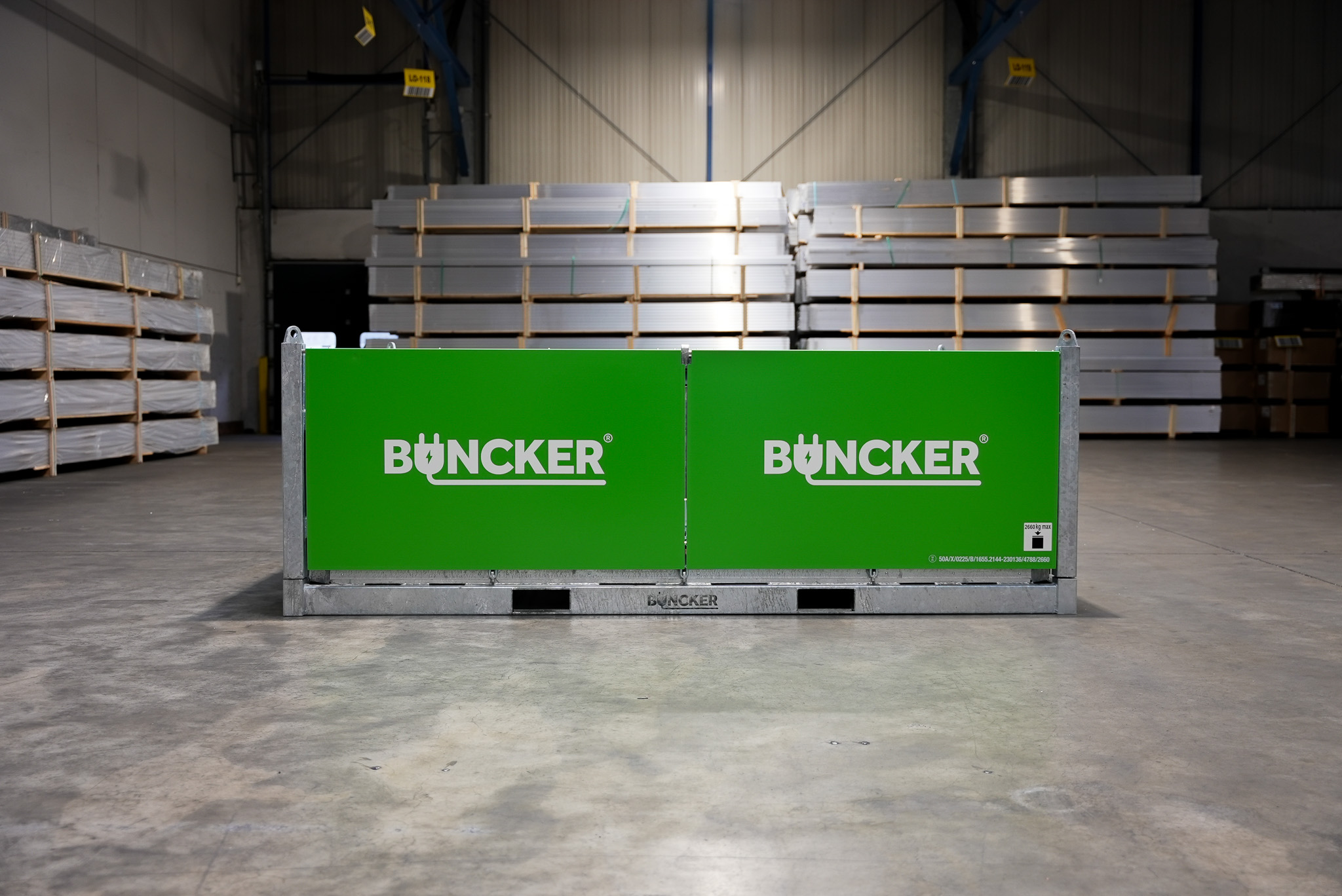
8. Red Flags and an Acceptance Checklist
These signals should stop a booking until resolved.
- The shipper cannot name the UN number, or the UN number does not match the battery described.
- Batteries are declared as “spare parts”, “electronics” or “machinery” with no dangerous goods information.
- The battery is used, returned or recalled, but no condition assessment is offered.
- The shipper asks for air freight for a battery described as damaged, swollen, faulty or “for inspection”.
- Packages are visibly damaged, swollen, warm, leaking or smell of solvent at intake.
- The packaging marking does not match the packing instruction claimed, or no packaging certificate is available for P911 or LP906.
- The shipper pushes back on written information, or insists the forwarder signs as consignor without providing data.
Before confirming a battery booking, each point below should be backed by a document or record.
- ✅ Classification in writing. Has the shipper provided the UN number, proper shipping name, chemistry and any special provision, in writing, as ADR 1.4.2.1.3 expects of a third party using a consignor?
- ✅ Your role defined. Is it clear whether your company acts as consignor, packer, loader or only as booking agent, and does your DGSA know?
- ✅ Condition confirmed. Is the battery documented as new, used, returned, damaged, recalled or for recycling, and is there an SP 376 assessment where needed?
- ✅ Unknown treated as severe. Are batteries of unknown condition routed and packed as the higher SP 376 tier?
- ✅ State of charge. Is the state of charge stated, and within 30 per cent for any air leg?
- ✅ Packaging approved. Does the packaging match the packing instruction, carry the right marking and cover every mode on the route?
- ✅ Carrier acceptance. Has each airline, shipping line, rail operator and haulier confirmed acceptance for this specific consignment?
- ✅ Air check. Are damaged, defective and recalled batteries excluded from air routes?
- ✅ Documents consistent. Do the transport document, packing certificate or Shipper’s Declaration, invoice and safety data sheet agree?
- ✅ Consolidation plan. Are mixed loading and segregation checked, and is the packing certificate signed by someone who saw the load?
- ✅ Interim storage. Is there a separated, monitored area or certified containment for batteries waiting between legs?
8.1 When to refuse
Refuse, or put on hold, any booking where the shipper cannot or will not provide classification and condition information, where a damaged or unknown battery is offered for air, where packaging is not approved for the tier the battery belongs to, or where no carrier on the route will accept it. Under ADR 1.4.2.2.3, a carrier that finds an infringement must not forward the consignment until it has been remedied; a forwarder that applies the same discipline at the desk protects its carriers, its staff and its own liability.
Bottom line: a forwarder cannot see inside every battery, but it can insist on answers before the battery moves. Get classification and condition in writing, know which role you are playing, book every leg with confirmed acceptance, keep damaged batteries off aircraft and use certified containment where condition is uncertain.
Frequently Asked Questions
Frequently Asked Questions
Yes. ADR 1.2.1 defines the consignor as the enterprise that consigns dangerous goods on its own behalf or for a third party, and, under a contract for carriage, as the consignor according to that contract. A forwarder that contracts the carriage in its own name takes on the consignor’s duties in 1.4.2.1. The shipper must then inform it in writing and provide the necessary information and documents (1.4.2.1.3).
Often, yes. ADR 1.8.3.1 requires a safety adviser for undertakings whose activities include consigning or carrying dangerous goods by road, or the related packing, loading, filling or unloading, subject to the exemptions in 1.8.3.2. UK HSE guidance specifically mentions forwarders and consolidators acting as intermediate unloaders.
No. Damaged, defective or recalled lithium batteries with the potential for a dangerous evolution of heat, fire or short circuit are forbidden for air transport, regardless of packaging. They can travel by road, rail or sea in packaging that matches their SP 376 tier.
Under the IMDG Code, a dangerous goods transport document (5.4.1) from the shipper and a container/vehicle packing certificate (5.4.2) from whoever packs the container. They may be combined in one multimodal form. The shipping line will also apply its own acceptance requirements.
As high risk. Ask the shipper for an SP 376 assessment; if none is available, the battery should not be booked as intact, should be kept off air routes and should travel in packaging approved for the higher tier, P911 or LP906. The classification itself remains the consignor’s responsibility.
Largely, but under their own entries, UN 3551 and UN 3552. Since ADR 2025, SP 376 and SP 377 and packing instructions P908/LP904, P909 and P911/LP906 also apply to sodium-ion batteries. By air, UN 3551 batteries shipped alone are cargo aircraft only and limited to 30 per cent state of charge.
Yes. All six models are UN LP906 certified for road (ADR), sea (IMDG) and rail (RID) and for indoor and outdoor storage, so one unit can stay with the battery across surface legs and storage periods. Damaged batteries still cannot fly. Fit should always be checked against the product space and maximum battery weight of the chosen model.
Accept Battery Freight with Confidence
BUNCKER® units are UN LP906 certified for road, sea and rail transport and for indoor and outdoor storage, with HF neutralisation and no filler materials required. Our specialists can help forwarders and 3PLs choose containment for damaged, defective or unknown-condition batteries.