
BESS Decommissioning and Module Transport
Taking a battery energy storage system out of service is as much a logistics project as an electrical one. This guide follows the modules from the decision to decommission through removal, condition assessment, classification, transport and interim storage to second life or recycling, and sets out where certified containment adds value and where it is not required.
1. Why BESS Decommissioning Is a Logistics Problem
Most decommissioning plans for battery energy storage systems start with the electrical work: isolating the system from the grid, disconnecting strings and making the site safe for the crew. That work matters, but it is only the first step. Once the modules come out of their racks, every one of them becomes a consignment of dangerous goods that has to be assessed, classified, packed, moved, often stored for a while and finally handed over to a repurposer or a recycler.
Several features make that chain harder than it looks.
- Energy per item. A stationary storage module or rack-level battery holds far more energy than a consumer battery, and it remains charged unless it is deliberately discharged. Even a partly discharged module is an energy source that can sustain a thermal event.
- Volume and repetition. A single site can contain many racks and hundreds of modules. Any weakness in the procedure is repeated for every pallet that leaves the site.
- Mixed condition. Modules from the same system rarely leave in the same state. Most may be intact, some may show swelling, faults or water damage, and after an incident a share of them may be unstable.
- Several owners of risk. The asset owner, the EPC or O&M contractor, the haulier, the storage hub and the recycler each hold part of the chain. Responsibilities that are not written down tend to fall between them.
When a module in that chain does fail, the consequences follow a familiar pattern: heat, venting, flammable and toxic gases and the risk of the event spreading to neighbouring modules. Our explainer on what happens when a module overheats uncontrollably describes that mechanism. For operators who need to hold or move modules of uncertain condition, our overview of containment for stationary storage operators shows how certified units are applied to energy storage sites.
Key principle: plan the decommissioning of a BESS around the condition of each module, not around the system as a whole. Classification, packaging, transport mode and storage all follow from that condition.
2. Triggers and the Decommissioning Plan
The reason a system is taken out of service shapes the whole project, because it largely determines the condition of the modules.
2.1 Three common triggers
- End of life. Capacity has faded, availability has dropped or the warranty and service agreements are ending. Modules are usually intact but aged, and the question is whether they have a second life or go straight to recycling.
- Repowering. The site stays in use, but modules, racks or whole containers are replaced with newer technology, sometimes a different chemistry. Old modules leave while new ones arrive, often on the same days and through the same gate.
- Incident damage. A thermal event, fire, flood, impact or BMS fault affects part of the system. Some modules are visibly damaged, others have an unknown history, and the site may still be under investigation.
2.2 The decommissioning plan
A written plan, agreed before the first module is touched, keeps the chain under control. A practical sequence looks like this.
For repowering projects, include the inbound flow in the same plan. New or replacement modules are usually intact batteries that the manufacturer has prepared for carriage, but they still need a delivery window, a secure area and clear separation from outgoing modules whose condition may be worse.
3. Condition Assessment and State of Health
Every later decision depends on the condition assessment, so it deserves the most care. It combines two sources of evidence: data from the battery management system and a physical inspection.
3.1 BMS data and Article 14
Under the EU Battery Regulation (EU) 2023/1542, Article 14 requires that the battery management system data needed to determine state of health and expected lifetime be accessible, including to independent operators who want to assess a battery for repurposing or remanufacturing. For decommissioning, that means cell voltages, temperatures, fault logs, cycle counts and state of health estimates should be extracted before the system is switched off for the last time. The wider effect of the regulation on transport and reverse flows is set out in our overview of logistics duties under Europe’s battery framework.
3.2 Visual and physical inspection
- Swelling, deformation or cracks in the module casing
- Electrolyte leaks, a sweet or chemical smell, corrosion or discolouration
- Heat marks, soot or melted connectors from a nearby event
- Evidence of water ingress, condensation or flooding
- Modules with cell voltages outside the OEM’s limits, or with active fault codes
3.3 The decision tree
| Category | Typical evidence | Next step |
|---|---|---|
| Intact | No visible damage, BMS data within limits, known history | Second life assessment or recycling as intact battery |
| Damaged or defective | Faults, minor casing damage, water exposure, but stable and cool | SP 376, P908 / LP904; quarantine before onward movement |
| Critical | Swelling, heating, venting, leaks, involvement in a fire or unknown history | SP 376, P911 / LP906; isolated storage in certified containment |
| For recycling | Intact but at end of life, no second life value | SP 377 / P909, unless damaged, in which case SP 376 applies |
Where data is missing or the evidence is mixed, treat the module as belonging to the more severe category. A module whose condition cannot be established with confidence should not be shipped as intact.
4. Classification and Packaging by Condition
The classification of a removed module follows from the assessment. The wording below summarises the provisions; your DGSA should check procedures against the edition of ADR, RID or the IMDG Code in force.
4.1 Intact modules: UN 3480 and P903(2)
Modules removed from a BESS and shipped on their own are UN 3480 LITHIUM ION BATTERIES. For intact, robust modules there is good news: under P903(2), batteries or battery assemblies with a gross mass of 12 kg or more and a strong, impact-resistant outer casing may be carried in strong outer packagings, in protective enclosures such as crates, or on pallets, without UN performance-tested packaging. Certified containment is therefore not a legal requirement for every intact module, and it is honest to say so. The conditions still apply: terminals must be protected against short circuits, modules must be secured against movement and the outer casing must genuinely be robust.
4.2 Damaged and defective modules: SP 376
Modules that are damaged or defective fall under special provision 376. Those that are not liable to react dangerously under normal conditions of carriage are packed under P908 or LP904. Those that are liable to disassemble rapidly, react dangerously, produce a flame or a dangerous evolution of heat, or emit toxic, corrosive or flammable gases are packed under P911 or LP906. Our article on Special Provision 376 risk tiers explains that judgement in more detail. For the critical tier, packaging must be shown to contain the effects of a thermal runaway, and it is worth knowing how large packagings earn LP906 approval before selecting a supplier.
4.3 Modules for recycling: SP 377 and P909
Intact batteries sent for disposal or recycling can be carried under special provision 377 and packing instruction P909. Once a module is damaged or defective, SP 376 takes precedence.
4.4 Whole containers: UN 3536
When a containerised BESS moves as a unit, with batteries designed to supply power outside the unit, the entry is UN 3536 LITHIUM BATTERIES INSTALLED IN CARGO TRANSPORT UNIT. Special provision 389 requires the batteries to be securely attached to the interior structure, such as racks or cabinets, to prevent short circuits, accidental operation and significant movement. That route suits relocation of an intact container. It is not appropriate for a container with damaged modules inside, which normally have to be removed and classified individually.
| Situation | Route | Certified containment needed? |
|---|---|---|
| Intact module, 12 kg or more, robust casing | UN 3480, P903(2) | Not required crates or pallets permitted |
| Intact module for recycling | UN 3480, SP 377 / P909 | Not required P909 packaging |
| Damaged, not liable to react dangerously | SP 376, P908 / LP904 | Specified packaging LP906 units also acceptable |
| Damaged, liable to react dangerously, or unknown | SP 376, P911 / LP906 | Required certified thermal runaway containment |
| Intact containerised BESS moved whole | UN 3536, SP 389 | Not applicable the container is the unit |
Stationary storage is no longer exclusively lithium-ion. Sodium-ion cells are appearing in new systems, and they have their own UN entries; our guide to sodium-ion chemistry in dangerous goods law covers their classification before you assume a lithium entry applies.
5. Transport Modes and State of Charge
Most decommissioned modules travel by road, and many cross borders by rail or sea on the way to a repurposer or recycler. Each mode has its own limits.
- Road (ADR) and rail (RID). Intact, damaged and critical modules can all be carried, provided the packing instruction for their category is followed and the vehicle and documents meet the requirements for Class 9. Carrier acceptance policies may be stricter than the regulations, especially for SP 376 consignments.
- Sea (IMDG Code). Modules and SP 376 consignments can go by sea in the appropriate packaging. For containerised systems under UN 3536, industry guidance on Amendment 42-24, mandatory from 1 January 2026, reports a move to on-deck stowage; confirm stowage and acceptance with the shipping line for each booking.
- Air. Damaged or defective lithium batteries are forbidden. Intact UN 3480 batteries are restricted to cargo aircraft only, and air rules limit their state of charge. In practice, BESS modules rarely travel by air.
5.1 State of charge
The state of charge has a direct influence on how likely a module is to go into thermal runaway and how severe the event becomes. For air, lithium-ion batteries under UN 3480 must be offered at a state of charge not exceeding 30 per cent of rated capacity. For road, rail and sea, set a reduced state of charge as standard practice in your decommissioning plan, agree the target with the OEM and the receiving party, and record it per module. Damaged modules often cannot be discharged safely; do not attempt it without the OEM’s procedure, and rely on the packaging tier instead. Our comparison of maritime versus aviation dangerous goods codes sets out how the two regimes treat lithium batteries.
One unit, several modes. A module that leaves a site by road, crosses to a hub by rail and continues by sea should not need repacking at each handover. Repacking a damaged module is a moment of risk in itself, so choose packaging that is accepted for every mode on the route.
6. Interim Storage on Site and at Hubs
Few decommissioned modules go straight from the rack to their final destination. They wait on site for transport, at a consolidation hub for a full load, or at the recycler for a processing slot. That waiting time is where storage rules apply.
6.1 Quarantine and separation
- Separate by condition. Keep intact, damaged and critical modules in distinct, marked zones. Critical modules should not share space with intact stock.
- Keep inbound and outbound apart. During repowering, new modules should not be stored next to removed modules awaiting assessment.
- Monitor. Log temperature checks or use thermal imaging for damaged modules, and escalate any rising trend.
- Plan for the fire service. Give the local fire service a site plan that shows where batteries are held and in what condition.
For broader principles of distance, detection and layout, our guidance on separation and detection for battery depots applies to both indoor and outdoor storage.
6.2 The Netherlands: PGS 37
In the Netherlands, PGS 37-1 covers energy storage systems of 20 kWh and above, so it applies to the operating BESS itself. PGS 37-2 covers the storage of lithium energy carriers, which makes it the relevant guideline once modules have been removed and are held on site or at a hub. Themes include separation, fire compartments, detection, the condition of stored batteries and emergency planning. Discuss your interim storage arrangement with the competent authority and the fire service, and check whether your location falls under PGS 37-2.
6.3 Toxic gas in enclosed spaces
A venting module releases hydrogen fluoride as well as flammable gases. Outdoors these gases disperse; in a container, a battery room or a warehouse they accumulate. If damaged modules must be held indoors, consider how gas would be contained or removed, and read our briefing on HF build-up in poorly ventilated spaces when writing the risk assessment.
7. Destinations: Second Life, Recycling and Take-Back
7.1 Repurposing and second life
Modules with good state of health may be repurposed for less demanding applications. Under the EU Battery Regulation, a repurposed or remanufactured battery is considered to be placed on the market anew and must comply with the regulation in full. The repurposer therefore needs reliable BMS data and a documented history, which is another reason to capture data before shutdown and keep module-level records. Keep those records with the module so they can travel to the next owner.
7.2 Recycling and take-back
Producers of industrial batteries must take back waste batteries free of charge. For asset owners, that makes the producer’s take-back route the first question to ask, before tendering transport and recycling separately. Modules that go to recycling pass through triage, waste shipment rules and intake storage at the plant; our article on moving end-of-life modules to recyclers follows that flow.
7.3 Where BUNCKER® fits
BUNCKER® does not contain whole containerised BESS units. Its role is the modules that need more than a crate or a pallet: damaged, defective or unknown-condition modules, modules recovered from an incident site, and modules held in interim storage on site or at a hub. buncker.com states that BUNCKER® is approved for both transport and temporary storage applications for BESS modules.
All six models are UN LP906 certified: the side-loading SDR (45.8 kWh), for batteries in any status, and the S (50 kWh), M (90 kWh), L (90 kWh), XL (100 kWh) and XXL (200 kWh). They are certified for road (ADR), sea (IMDG) and rail (RID) and for indoor and outdoor storage, so one unit can cover several modes and the storage period between them. Each is built around a patented bell jar with no filler materials; the Fibercon Altilium® CP Blanket (FACB) chemically neutralises HF, and the outer surface stays below 100 °C during a full thermal runaway. Units are made in the Netherlands by VDL, supported by a certified service and inspection programme and delivered from stock.
For mid-size BESS modules and residential storage battery stacks, the 100 kWh Model XL is the recommended starting point, with a maximum battery weight of 800 kg; see the datasheet for dimensions. For the largest industrial modules, the 200 kWh flagship containment unit offers a product space of 2520 × 1720 × 550 mm and a maximum battery weight of 1,540 kg. Always check the module’s footprint, height and mass, including any tray or lifting frame, and follow a structured method for picking containers when comparing options.
BUNCKER® Model XXL for Industrial BESS Modules
Certified containment rated up to 200 kWh for the largest industrial energy storage batteries, with HF neutralisation and no filler materials. UN LP906 certified for road, sea and rail transport and for indoor and outdoor storage. Always check fit against the dimensions and weight of your specific module.
See energy storage solutions →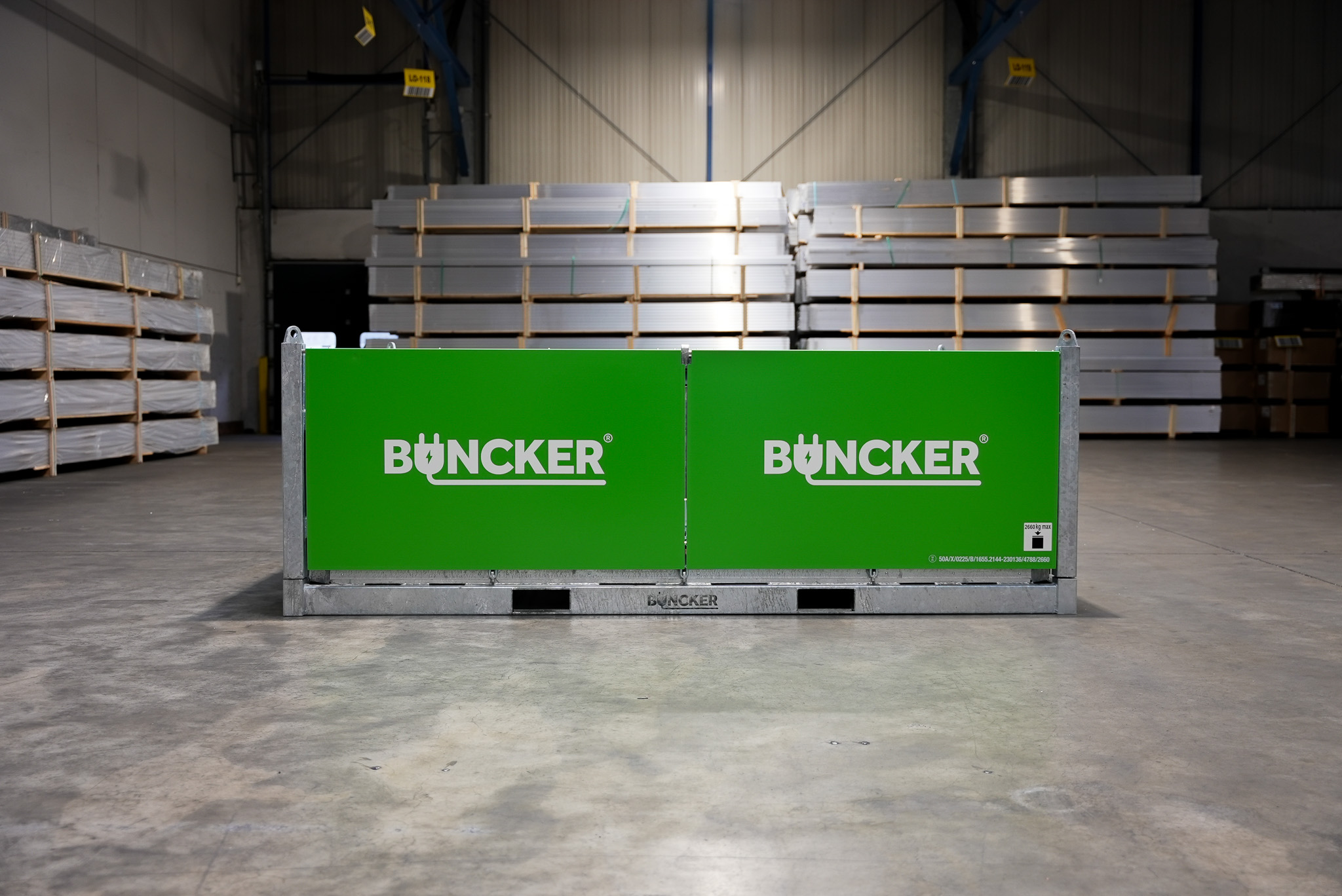
8. Decommissioning Checklist
Use this checklist to set up or review a BESS decommissioning project. Each point should be backed by a procedure, a record or a certificate.
- ✅ Trigger and scope. Is the reason for decommissioning recorded, and does the plan cover outbound and, for repowering, inbound modules?
- ✅ Data capture. Has BMS data, including state of health and fault history, been extracted before final shutdown?
- ✅ Isolation. Is isolation carried out under the OEM’s procedure by trained high-voltage staff?
- ✅ Condition per module. Is every module sorted into intact, damaged, critical or for recycling, and recorded against its serial number?
- ✅ Classification. Are intact modules under UN 3480 and P903(2) checked for mass and casing, and damaged modules assigned to the right SP 376 tier?
- ✅ Unknown condition. Are modules with missing data or mixed evidence treated as critical?
- ✅ Whole containers. If a container moves under UN 3536, are the batteries securely attached under SP 389 and is the content intact?
- ✅ State of charge. Is a target state of charge agreed and recorded, and are damaged modules left undisturbed unless the OEM allows discharge?
- ✅ Mode planning. Has acceptance been confirmed with each carrier, and are damaged modules kept off air routes?
- ✅ Interim storage. Are modules separated by condition, monitored and, in the Netherlands, stored in line with PGS 37-2?
- ✅ Containment fit. Have module dimensions and mass been checked against the product space and maximum battery weight of the containment unit?
- ✅ Destination. Has the producer’s take-back route been checked, and does any repurposer have the data needed to place the battery on the market anew?
Bottom line: a decommissioned BESS turns into many separate consignments, each with its own condition. Capture the data, assess every module, use simple packaging where the rules allow it, and reserve certified containment for the modules that are damaged, uncertain or waiting in storage.
Frequently Asked Questions
Frequently Asked Questions
Not always. Under P903(2), intact batteries or assemblies with a gross mass of 12 kg or more and a strong, impact-resistant outer casing may be carried in strong outer packagings, protective enclosures such as crates, or on pallets, without UN performance-tested packaging. Terminals must still be protected and the modules secured against movement.
Lithium-ion modules shipped on their own are UN 3480. A containerised system moved whole, with batteries designed to supply power outside the unit, is UN 3536. Damaged or defective modules remain UN 3480 but are carried under special provision 376.
Under SP 376. Modules that are not liable to react dangerously are packed under P908 or LP904; those that are liable to react dangerously, or whose condition cannot be established, are packed under P911 or LP906 in packaging shown to contain a thermal runaway.
A reduced state of charge lowers the likelihood and severity of a thermal event and is good practice for every mode. By air, UN 3480 batteries are limited to a state of charge of no more than 30 per cent. Damaged modules should only be discharged if the OEM’s procedure allows it.
Yes, if storage is planned. Separate modules by condition, monitor damaged ones and agree the layout with the fire service. In the Netherlands, PGS 37-2 is the relevant guideline for storing lithium energy carriers. Critical modules are best held in certified containment that is also approved for storage.
Under Regulation (EU) 2023/1542, producers of industrial batteries must take back waste batteries free of charge. Check the producer’s take-back arrangements early in the plan. Batteries that are repurposed instead are treated as placed on the market anew and must comply with the regulation in full.
No. BUNCKER® units are designed for modules and battery stacks once they have been removed from the system. All six models are UN LP906 certified for road, sea and rail transport and for indoor and outdoor storage. Fit should always be checked against the product space and maximum battery weight of the chosen model.
Contain the Modules That Need It
BUNCKER® units are UN LP906 certified for road, sea and rail transport and for indoor and outdoor storage, with HF neutralisation and no filler materials required. Our specialists can help you check fit and choose containment for damaged, defective or unknown-condition BESS modules.