
UN Certification
UN P911 & LP906
The Gold Standard for Lithium Battery Packaging
Understanding the highest-level UN certifications for lithium battery transport packaging and what they mean for your operations.
LP906
P908
All Battery Types
Thermal Runaway Containment
What is UN P911?
UN P911 is a packaging instruction defined within the United Nations Model Regulations on the Transport of Dangerous Goods, commonly referred to as the "Orange Book." It is the most stringent packaging instruction specifically written for lithium batteries that are no longer in their intended operational state.
P911 applies to lithium batteries that are classified as "not fully protected by their design", a category that explicitly includes defective batteries, damaged batteries, and batteries that are merely suspected of being defective or damaged. This is a critical distinction: even a battery you are not sure about must be treated as if it requires P911-level containment.
The standard goes significantly further than P908. Where P908 provides basic containment for medium-risk damaged batteries, P911 mandates that packaging must be capable of:
- Containing a full thermal runaway event, including fire and off-gases
- Filtering hazardous hydrofluoric (HF) gases produced during cell venting
- Keeping the outer surface temperature below 100°C throughout the event
- Retaining all material, no external release of burning material
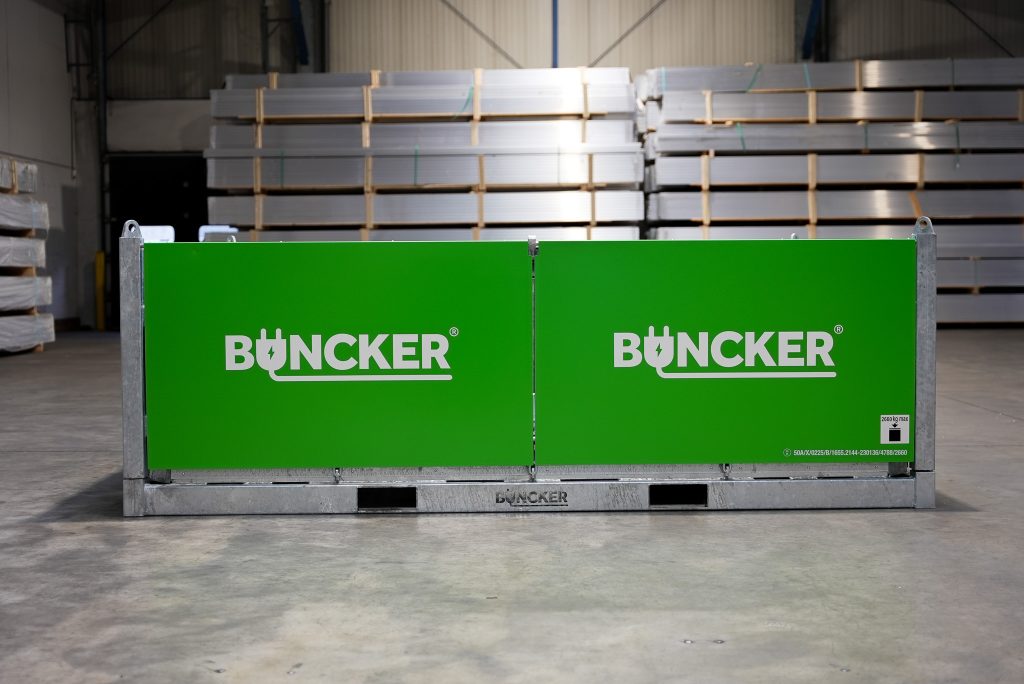
BUNCKER® was designed from the ground up to exceed every P911 requirement. Our patented Fibercon Altilium CP Blanket (FACB) material and bell jar construction address each specification directly, without the need for sand, vermiculite or other inconvenient filler materials.
P908 vs P911 vs LP906, What Is the Difference?
The UN Model Regulations define three levels of packaging instruction for damaged or defective lithium batteries. Understanding the distinction is essential for correct classification and transport documentation.
UN P908
Designed for damaged or defective batteries with a moderate risk profile. Requires basic containment and non-combustible cushioning material. No thermal runaway containment requirement.
- Basic outer packaging
- Non-combustible cushioning
- No HF gas filtration required
- No outer temperature limit
UN P911
For the highest-risk batteries, defective, damaged, or suspected. Requires full thermal runaway containment, HF gas filtration and a maximum outer surface temperature of 100°C.
- Full thermal runaway containment
- HF gas filtration mandatory
- Outer surface <100°C
- All battery types accepted
LP906
The Large Packaging equivalent of P911, applies to packaging exceeding 400 kg gross mass or 450 litres capacity. Carries all the same performance requirements as P911.
- All P911 requirements apply
- For packages >400 kg / >450 L
- Industrial & EV battery focus
- Highest certification available
How BUNCKER® Meets P911 & LP906
Every design decision in BUNCKER® is traceable to a specific requirement in P911 or LP906. There are no compromises and no workarounds, each feature exists to meet or exceed the specification.
- Thermal runaway containment Certified
- HF gas filtration (FACB material) Certified
- Outer surface temperature <100°C Verified
- All battery types accepted Confirmed
- No external venting required during event Verified
- Patented bell jar no filler materials Patented
- LP906 certification (large packaging) Certified
- P908 backward compatibility Confirmed
P911 / LP906 Across All Transport Modes
The P911 and LP906 instructions are referenced across all four major international transport regulations. A single BUNCKER® certification covers all modes.
Road, ADR
P911 and LP906 are directly referenced in ADR Special Provision 376 for damaged and defective lithium batteries transported by road.
Sea, IMDG
The IMDG Code adopts P911/LP906 for Class 9 lithium batteries transported in dangerous condition by sea, aligned with UN Model Regulations.
Air, IATA
IATA DGR references equivalent packaging requirements via Packing Instructions PI 965–970 and applies the most restrictive interpretation for air transport.
Rail, RID
RID aligns directly with ADR for lithium batteries and applies P911/LP906 in the same manner for international dangerous goods rail transport.
Frequently Asked Questions
Answers to the most common questions about UN P911 and LP906 certification.
Is BUNCKER® certified for damaged lithium batteries?
Yes. BUNCKER® is UN P911 and LP906 certified, the certifications specifically designed for damaged, defective and suspected lithium batteries. This is the highest available classification. You can transport batteries in any condition, including those involved in a previous incident, using BUNCKER® packaging.
Do I need filler materials with BUNCKER®?
No. BUNCKER®'s patented bell jar design eliminates the need for sand, vermiculite or any other filler material. Traditional P911-compliant solutions typically require these materials to absorb thermal energy and suppress fire propagation. BUNCKER®'s FACB liner and bell jar construction achieve the same result without any filler, dramatically simplifying the packing process and reducing weight.
Which BUNCKER® models are LP906 certified?
LP906 certification applies to BUNCKER® models L, XL and XXL, the larger units exceeding 400 kg gross mass or 450 litres capacity. All five models (S, M, L, XL, XXL) hold UN P911 certification. Contact our team for a model-specific certification matrix.
How does LP906 differ from P911?
LP906 is the "Large Packaging" version of P911. The performance requirements, thermal runaway containment, HF gas filtration, outer temperature limit, are identical. The distinction is purely about size: once a packaging exceeds 400 kg gross mass or 450 litres internal volume, it falls under LP (Large Packaging) instructions. LP906 is therefore the highest possible certification level for industrial-scale lithium battery packaging.
Questions about P911 compliance for your application?
Our compliance team can advise on the correct BUNCKER® model, help with documentation and provide a full certification package for your DGO records.