
Battery Recycling Logistics: From Collection Point to Recycler
End-of-life batteries travel through more hands, more sites and more uncertainty than new ones. This guide follows a waste battery from the collection point through triage, consolidation and carriage to the recycler’s gate, and sets out the dangerous goods, waste shipment and storage rules that apply at each step.
1. Why Recycling Logistics Is the Riskiest Leg
A new battery leaves the factory with a known design, a test summary, a state of charge set by the manufacturer and packaging specified for it. A waste battery has none of these certainties. By the time it reaches a collection point it may have been dropped, crushed, overcharged, flooded, opened by an amateur repairer or left in a hot shed for a summer. Its label may be missing, its chemistry may be unknown and its state of charge is anyone’s guess.
That uncertainty is what makes the recycling leg the most demanding part of the battery lifecycle from a logistics perspective. Three factors combine.
- Unknown condition. Many batteries enter the waste stream precisely because something has gone wrong with them. Swelling, corrosion, impact damage and internal faults are common, and not all of them are visible from the outside.
- Mixed chemistries and formats. A single collection container can hold lithium-ion phone cells, lithium metal coin cells, e-bike packs, power tool batteries, alkaline cells and, increasingly, sodium-ion cells. Each behaves differently, and a single failing cell can affect everything around it.
- Volume growth. Electric vehicles, light means of transport and stationary energy storage are reaching end of life in growing numbers, alongside production scrap from gigafactories. Packs that weigh hundreds of kilograms now share the same chain as portable batteries weighing a few grams.
The hazard behind all three is thermal runaway. A damaged lithium cell can heat itself to the point where it vents flammable and toxic gas, ignites and passes its heat to neighbouring cells. Our guide to the self-heating chain reaction in damaged cells explains the mechanism. In a recycling chain, the practical question is not whether such an event can happen, but where it will happen and whether the packaging around the battery will hold it.
Key principle: in recycling logistics, condition is the variable that drives everything else. Packaging, carriage, documentation and storage should all be specified on the assumption that some batteries in the stream are worse than they look. Recyclers, collection scheme operators and 3PLs that build their chain around this assumption need certified containment from collection to recycler intake rather than ad hoc packing at each site.
2. The Recycling Chain Mapped
Every recycling chain is different in detail, but most follow the same sequence. Mapping it step by step shows where condition is assessed, where batteries are handled, and where packaging decisions are made or remade.
The weak points are the transitions. Each time a battery is unpacked, sorted, repacked or transferred between carriers, it is handled by someone new and potentially placed in packaging that does not match its condition. Large-format packs make this especially visible: the logistics of returning large traction packs from dealers show how much effort is saved when a pack is placed in suitable packaging once and stays in it until it reaches the recycler.
3. Triage and Classification
Triage is the most consequential step in the chain. Under ADR, RID and the IMDG Code, a waste lithium battery is still dangerous goods of Class 9, and its condition determines which special provision and packing instruction apply. Three categories matter for recycling streams.
3.1 Intact batteries for recycling: SP 377 and P909
Special Provision 377 allows lithium ion and lithium metal cells and batteries, and equipment containing them, that are carried for disposal or recycling to be packed in accordance with packing instruction P909, either together with or without non-lithium batteries. The key relief for recycling streams is that these batteries do not need to demonstrate compliance with the design type test requirements, which is essential when the test summary of a discarded battery is unknown. Packages are marked “LITHIUM BATTERIES FOR DISPOSAL” or “LITHIUM BATTERIES FOR RECYCLING”. The modal regulations may attach further conditions, and ADR contains additional relief for small collection quantities, so the precise limits should be confirmed with your Dangerous Goods Safety Adviser (DGSA) against the edition in force.
SP 377 does not cover batteries that have been identified as damaged or defective. Those must be assessed under SP 376. Since ADR and RID 2025, SP 376, SP 377 and packing instructions P908/LP904, P909 and P911/LP906 also apply to sodium-ion batteries (UN 3551 and UN 3552), which are now appearing in collection streams.
3.2 Damaged or defective: SP 376 with P908 / LP904
A battery that is damaged or defective, but not liable to rapidly disassemble, react dangerously, produce a flame or a dangerous evolution of heat, or emit toxic, corrosive or flammable gas under normal conditions of carriage, may be packed under P908 or the large packaging instruction LP904.
3.3 Critical: SP 376 with P911 / LP906
Where a damaged or defective battery is liable to react dangerously under normal conditions of carriage, P911 or LP906 applies. This is the highest packaging tier, and it requires packaging that has been shown to contain the effects of a thermal runaway event. For a structured approach to classifying defective batteries before carriage, see our detailed SP 376 article.
| Triage outcome | Provision | Packing instruction | Typical recycling examples |
|---|---|---|---|
| Intact, carried for recycling or disposal | SP 377 | P909 | Retail take-back cells, end-of-life tool and laptop batteries with no visible damage |
| Damaged or defective, not liable to react dangerously | SP 376 | P908 / LP904 | Swollen or cracked casings, recalled packs assessed as stable |
| Damaged or defective, liable to react dangerously | SP 376 | P911 / LP906 | Crash-damaged EV packs, fire-exposed or flooded modules, packs that are hot, smoking or leaking |
| Condition cannot be established | SP 376 (precautionary) | Treat as P911 / LP906 | Unlabelled packs without battery management data, items from fire scenes |
Triage is a competence, not a glance. Collection staff should have a written procedure, training and a clear escalation route when they are unsure. When the condition of a battery cannot be established with confidence, the safe default is to treat it as liable to react dangerously. Knowing what real fire testing for P911 involves helps teams understand why this tier exists and what it demands of packaging.
4. Packaging and Consolidation at Volume
Once triage has sorted the stream, the consolidation hub has to package it for onward carriage. At low volumes, almost any compliant approach will work. At the volumes now moving through European recycling chains, packaging choices have a direct effect on labour, floor space, safety and cost.
4.1 Mixed chemistries
Lithium-ion, lithium metal and sodium-ion batteries can arrive in the same load. Sodium-ion cells are newer to the stream and are carried under their own entries; our article on UN 3551 and UN 3552 consignments explains the entries and the special provisions that apply to them. Mixed loads should be identified on the transport document and the packaging should be suitable for every chemistry inside it.
4.2 Terminal protection and segregation
Short circuits are a leading cause of incidents in collection containers. Terminals of loose batteries should be taped or individually bagged, and packs should be prevented from moving against each other. Damaged stock must be physically separated from intact stock, so that a single failing battery cannot compromise a container of otherwise stable batteries, and so that the packing instruction on the label matches the contents.
4.3 Why filler-based packing scales badly
Traditional packing for damaged batteries relies on loose filler such as sand or vermiculite. It works for single items, but it becomes a bottleneck as volumes grow.
For large packs, capacity matters as much as certification. Containment should be rated for the full energy content of the largest battery it will carry, and loading geometry should suit the pack format. Our criteria for selecting large-format containment cover these questions in detail. Where a hub receives batteries of every status and format, a side-loading unit such as the SDR for mixed-status loads avoids having to match each item to a different packaging type.
5. Transport Modes for Waste Batteries
Waste batteries move by road, rail and sea under the same dangerous goods framework as new batteries, with the special provisions described above. Air is effectively closed to recycling consignments.
| Mode | Regime | Status for waste and damaged batteries | Practical notes |
|---|---|---|---|
| Road | ADR | Permitted under SP 376 / SP 377 | The backbone of collection and consolidation. Driver training, vehicle equipment and documentation apply as for other Class 9 loads. |
| Rail | RID | Permitted under SP 376 / SP 377 | Suited to long-distance flows from consolidation hubs to large recyclers. Packaging requirements mirror ADR. |
| Sea | IMDG Code | Permitted, with carrier acceptance | Relevant for island markets and intercontinental flows. Shipping lines may apply their own acceptance policies for damaged batteries. |
| Air | IATA DGR | Forbidden unless approved | Waste batteries and batteries for recycling or disposal are forbidden unless approved under Special Provision A183. Damaged, defective or recalled batteries with potential for dangerous heat, fire or short circuit are forbidden. |
Because air is not a realistic option, route planning for recycling consignments should be built around road, rail and sea from the start. If a battery has to cross water, our guide to choosing between ocean and air for batteries explains why sea carriage is the practical option for most recycling flows.
5.1 Documentation basics
A recycling consignment carries two sets of paperwork. The dangerous goods transport document records the UN number, proper shipping name, class and the applicable special provision, alongside the information required by the mode. The waste documentation, depending on the route, includes the movement document and any notification and consent required under waste shipment law. Both should describe the same consignment consistently. Mismatches between the two are a common reason for delays at borders and at recycler intake.
6. Cross-Border Shipments and the EU Framework
Recycling capacity in Europe is concentrated in a limited number of plants, so many waste batteries cross at least one border on their way to treatment. That brings waste law into play alongside dangerous goods law.
6.1 The Waste Shipment Regulation
Regulation (EU) 2024/1157 on shipments of waste entered into force on 20 May 2024, and most of its provisions apply from 21 May 2026. Most of its export rules apply from 21 May 2027. Under the regulation, shipments of hazardous waste between Member States are subject to the prior written notification and consent procedure: the notifier needs consent from the competent authorities of dispatch, transit and destination before the shipment can take place. Since 21 May 2026, these procedures run electronically through the Commission’s Digital Waste Shipment System (DIWASS).
Waste lithium-based batteries are classified as hazardous waste in the EU, so cross-border movements of these batteries will generally require notification. Collection scheme operators and recyclers should plan the lead time for consent into their schedules and confirm the applicable procedure with the competent authority for each route. The export of hazardous waste from the EU to non-OECD countries is banned.
6.2 The EU Battery Regulation: targets and EPR
Regulation (EU) 2023/1542 sets the targets that drive volume into the recycling chain. Producers carry extended producer responsibility for collecting and treating waste batteries, and the regulation sets the following targets, among others.
| Target | Level | Deadline |
|---|---|---|
| Collection of waste portable batteries | 63% / 73% | End 2027 / end 2030 |
| Collection of waste LMT batteries | 51% / 61% | End 2028 / end 2031 |
| Recycling efficiency, lithium-based batteries | 65% / 70% | 31 December 2025 / 31 December 2030 |
| Recovery of lithium | 50% / 80% | 31 December 2027 / 31 December 2031 |
| Recovery of cobalt, copper, lead and nickel | 90% / 95% | 31 December 2027 / 31 December 2031 |
In September 2026 the Commission reported on whether the recycling efficiency and material recovery targets should be revised and concluded that the current targets strike an appropriate balance between ambition and feasibility. For logistics teams, the message is that collected volumes and recycler throughput will keep rising. Our overview of what the new battery rules mean for carriers sets out the wider implications.
6.3 Black mass as hazardous waste
Commission Delegated Decision (EU) 2025/934 updates the EU List of Waste for battery-related waste. It introduces specific codes for battery manufacturing waste, waste batteries and recycling intermediates, and it classifies black mass as hazardous waste. The practical consequences are stricter oversight of black mass shipments within the EU and a ban on exporting it to non-OECD countries. The decision applies from late 2026; because its application date was the subject of a published corrigendum, check the current EUR-Lex text and your competent authority for the date that applies to your permits and shipments.
Permits, waste acceptance procedures, internal codes and outbound shipment arrangements for black mass may need updating to reflect its hazardous status. Recyclers that ship black mass to refiners in other Member States should expect the notification and consent procedure to apply.
7. Recycler Intake and On-Site Buffer Storage
The recycler’s gate is where the chain concentrates. Batteries from many collection points arrive in varying condition and wait, sometimes for days or weeks, before discharge and processing. Intake procedures and buffer storage determine whether one failing battery stays an isolated event.
7.1 Acceptance and quarantine
Every incoming consignment should be checked against its documents: declared packing instruction, chemistry, quantity and condition. Items that arrive warm, swollen, leaking or in packaging that does not match their declared status belong in a quarantine zone, physically separated from the main buffer store, until they have been assessed. Guidance on how to lay out battery quarantine zones covers separation distances, fire detection and the role of insurers’ standards.
7.2 Storage limits and dwell time
Permits and insurers typically set limits on the quantity of batteries stored on site and on how they are stored. Buffer stock grows quickly when processing lines are down for maintenance or when inbound volumes peak. Recyclers should know their permitted limits, monitor stock against them and plan for surges, rather than letting unprocessed batteries accumulate in temporary areas.
7.3 HF and the people on site
Venting lithium-ion cells release hydrogen fluoride. At a recycling plant, where staff work close to large quantities of stored batteries, the gas risk can be as significant as the fire risk. Understanding why HF gas outlasts the flames is part of any intake risk assessment.
7.4 Containment as transport and storage measure
Packaging that is certified for carriage and approved for indoor and outdoor storage can serve both roles. A critical battery packed under P911/LP906 at the collection point can stay in the same unit through transport and buffer storage until the recycler is ready to process it. That removes a repacking step at the moment the battery is least predictable, and it means the quarantine area holds contained batteries rather than exposed ones.
The BUNCKER® Pro Line Heavy range is built around a patented bell jar: the battery sits on the base and the containment body lowers over it and seals, with no sand or vermiculite required. The Fibercon Altilium® CP Blanket (FACB) chemically neutralises HF, and the outer surface stays below 100 °C during a full thermal runaway. All six models are UN LP906 certified for road (ADR), sea (IMDG) and rail (RID) and for indoor and outdoor storage: the side-loading SDR (45.8 kWh), for batteries in any status, and the pallet-loading S (50 kWh), M (90 kWh), L (90 kWh), XL (100 kWh) and XXL (200 kWh). Units are made in the Netherlands by VDL, supported by a certified service and inspection programme and delivered from stock. buncker.com states that the system covers all lithium batteries, including sodium batteries and mixed loads; for sodium-ion consignments, confirm the certificate scope against our LP906 compliance documentation before shipping.
BUNCKER® for Battery Recycling and Reverse Logistics
Certified containment for collection points, consolidation hubs and recycler intake. Patented bell jar architecture, Fibercon Altilium® CP Blanket HF neutralisation and no filler materials. UN LP906 certified for road, sea and rail transport and for indoor and outdoor storage, with an outer surface that stays below 100 °C during full thermal runaway. Six models from 45.8 kWh to 200 kWh, made in the Netherlands by VDL.
See recycling solutions →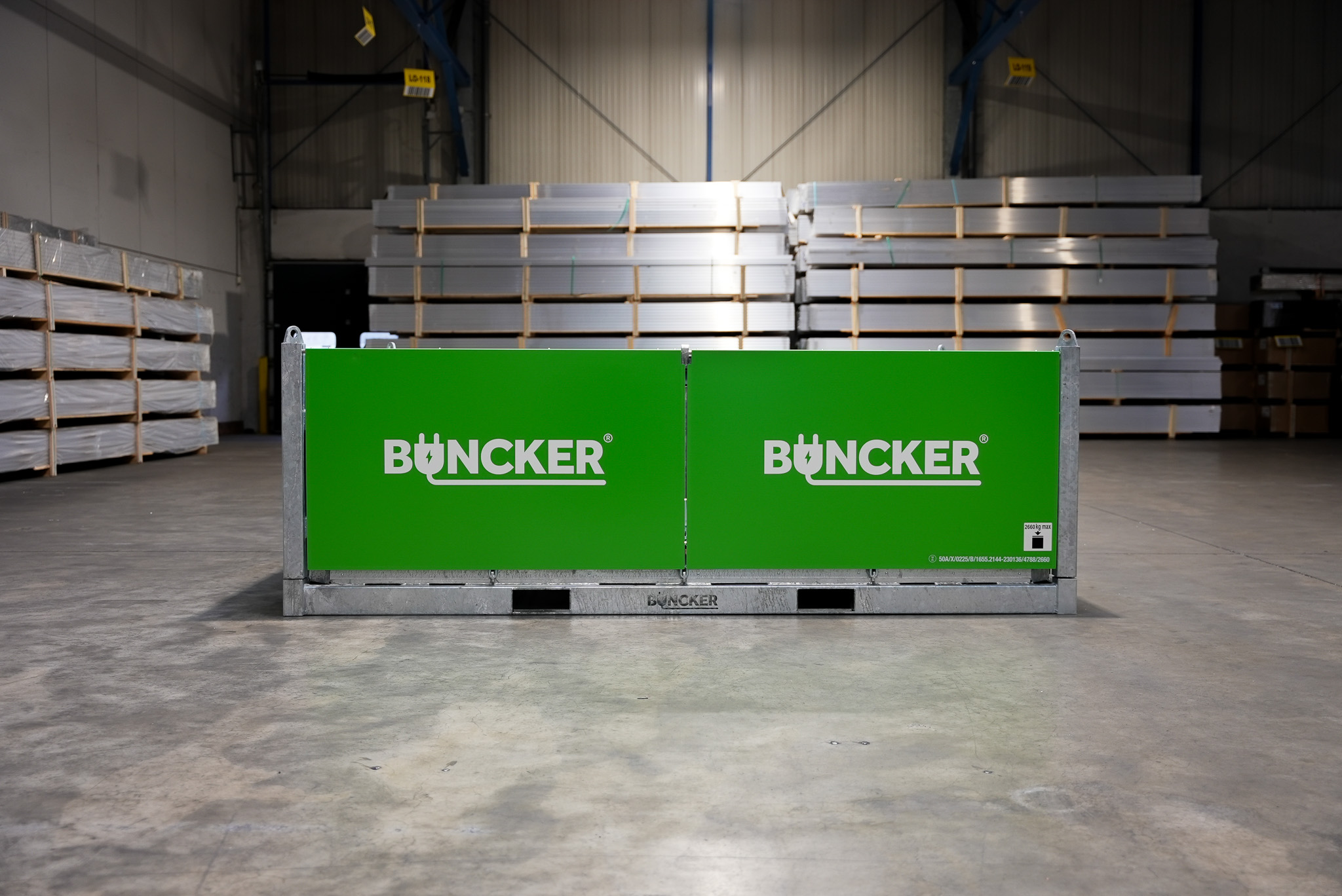
8. Checklist for Setting Up or Auditing a Recycling Chain
Use the checklist below when setting up a new recycling logistics chain or auditing an existing one. Each point should be answerable with evidence: a procedure, a certificate, a record or a permit.
- ✅ Triage procedure. Is there a written procedure for sorting batteries by chemistry and condition at every collection point and hub, with trained staff and a clear escalation route?
- ✅ Precautionary default. Are batteries of unknown condition treated as liable to react dangerously and packed under P911/LP906?
- ✅ Packing instruction match. Does every package carry the packing instruction that matches its contents: P909 for intact recycling stock, P908/LP904 for damaged stock, P911/LP906 for critical stock?
- ✅ Marking and documents. Are packages marked correctly for recycling or disposal, and do dangerous goods and waste documents describe the same consignment consistently?
- ✅ Sodium-ion and mixed loads. Are sodium-ion batteries identified under UN 3551 or UN 3552, and does the packaging certificate cover every chemistry in the load?
- ✅ Terminal protection. Are terminals of loose batteries protected and are packs prevented from moving against each other?
- ✅ Segregation. Is damaged stock physically separated from intact stock in collection, consolidation and storage?
- ✅ Mode planning. Are routes planned by road, rail and sea only, with no air leg unless an approval under A183 is in place?
- ✅ Waste shipment compliance. Are cross-border shipments notified through DIWASS where required, with consent received before dispatch?
- ✅ Black mass. Have permits, codes and outbound arrangements been updated for the hazardous classification of black mass?
- ✅ Intake and quarantine. Does the recycler have a defined acceptance check and a separated quarantine zone for suspect items?
- ✅ Storage limits. Are permitted on-site quantities known and monitored, with a plan for surges?
- ✅ Containment evidence. Is containment certified to LP906, rated for the energy content of the largest pack, filler-free and approved for both carriage and storage?
- ✅ Service and reuse. Is there a certified inspection and service programme for reusable containment, including after an event?
- ✅ Specialist sign-off. Has the DGSA reviewed the chain against the current editions of ADR, RID and the IMDG Code?
Bottom line: a recycling chain is only as safe as its least certain battery. Triage that errs on the side of caution, packaging that matches condition, and containment that stays with the battery from collection to processing turn an unpredictable stream into a manageable one.
Frequently Asked Questions
Frequently Asked Questions
It depends on condition. Intact batteries carried for recycling or disposal may be packed under P909 in accordance with Special Provision 377. Batteries identified as damaged or defective fall under SP 376: P908 or LP904 if they are not liable to react dangerously, and P911 or LP906 if they are. Your DGSA should confirm the applicable conditions for the edition of ADR, RID or the IMDG Code in force.
Under SP 377, lithium batteries carried for disposal or recycling are relieved from demonstrating compliance with the design type test requirements, which reflects the fact that test evidence for discarded batteries is often unavailable. The relief does not extend to batteries identified as damaged or defective, which must be assessed under SP 376.
Under the IATA rules, waste batteries and batteries shipped for recycling or disposal are forbidden by air unless approved under Special Provision A183. Damaged, defective or recalled batteries with the potential for dangerous heat, fire or short circuit are forbidden. Recycling routes should therefore be planned by road, rail and sea.
Since ADR and RID 2025, SP 376, SP 377 and packing instructions P908/LP904, P909 and P911/LP906 also cover sodium-ion batteries under UN 3551 and UN 3552. They should be identified correctly on the transport document, and the scope of any packaging certificate should be confirmed for sodium-ion consignments.
Under Regulation (EU) 2024/1157, which largely applies from 21 May 2026, shipments of hazardous waste between Member States are subject to prior written notification and consent, handled through the DIWASS system. Because waste lithium-based batteries are classified as hazardous waste, cross-border movements will generally need notification. Confirm the procedure for each route with the competent authorities concerned.
Yes. Commission Delegated Decision (EU) 2025/934 updates the EU List of Waste and classifies black mass as hazardous waste, which brings stricter shipment controls and bars exports to non-OECD countries. The decision applies from late 2026; check the current EUR-Lex text, including its corrigendum, for the exact date.
Yes, where the unit is certified for both. All BUNCKER® models are UN LP906 certified for road (ADR), sea (IMDG) and rail (RID) transport and for indoor and outdoor storage, so a critical battery can stay in the same unit from collection through transport to buffer storage at the recycler, without repacking and without filler material.
One Unit From Collection Point to Recycler
BUNCKER® units are UN LP906 certified for road, sea and rail transport and for indoor and outdoor storage, with HF neutralisation and no filler materials required. Our specialists can help you size containment for every stage of your recycling chain.
One Comment
Comments are closed.